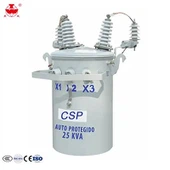
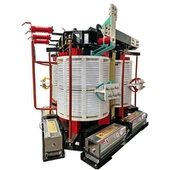
The lightning protection work for distribution transformers affected by lightning strikes has generally been done, but there are still two problems: ① poor grounding of lightning arresters; ② Only emphasizing the installation of lightning arresters on the high-voltage side and neglecting the issue of installing lightning arresters on the low-voltage side (especially in areas with frequent lightning strikes). If the grounding of the lightning arrester is poor and overvoltage occurs, the lightning arrester cannot discharge the current well, which will damage the insulation of the transformer; If a lightning arrester is not installed on the low-voltage side, when a large amount of lightning current is discharged to the ground by the high-voltage side lightning arrester, a voltage drop is generated at the grounding position. This voltage also acts on the neutral point of the low-voltage side winding while passing through the transformer casing, and the low-voltage side winding is grounded through the wave impedance of the low-voltage line. The following measures can be taken
① Sainaithin an talamh lochtanna a bhaineann le an tintreach gabháil agus re connect them mar required. Tabhair faoi deara go an talamh sreang de an tintreach arrester ba chóir a bheith go díreach ceangailte leis an shell de an claochladán agus an neodrach pointe ar an íseal-voltas taobh % 2c agus ansin an talamh gléas ba chóir a roinnt . Tá sé talamh friotaíocht ní níos mó ná 4 % ce a9% 3b % e2% 91% a1 Do limistéir le il stoirmeacha toirní % 2c a a set de ísealvoltas tintreach arresters ba chóir a bheith curtha ar an ísealvoltas taobh.
Bocht Talamh As Dáileadh Claochladán
Dec 27, 2023
Fág nóta
B’fhéidir gur mhaith leat freisin